
Williams Congruence Development System
Developed by Dr. Lloyd C. Williams, The Williams Congruence Development System (WCDS) provides a top-to-bottom methodological approach for assessing, aligning, developing, and implementing long-term organizational transformation. Unlike other development systems, the WCDS addresses people, systems, and organizational culture to ensure long-term success.
While discrete components of the WCDS framework can be leveraged for specific organizational challenges, clients often experience the greatest return on investment when engaging fully with the WCDS approach.
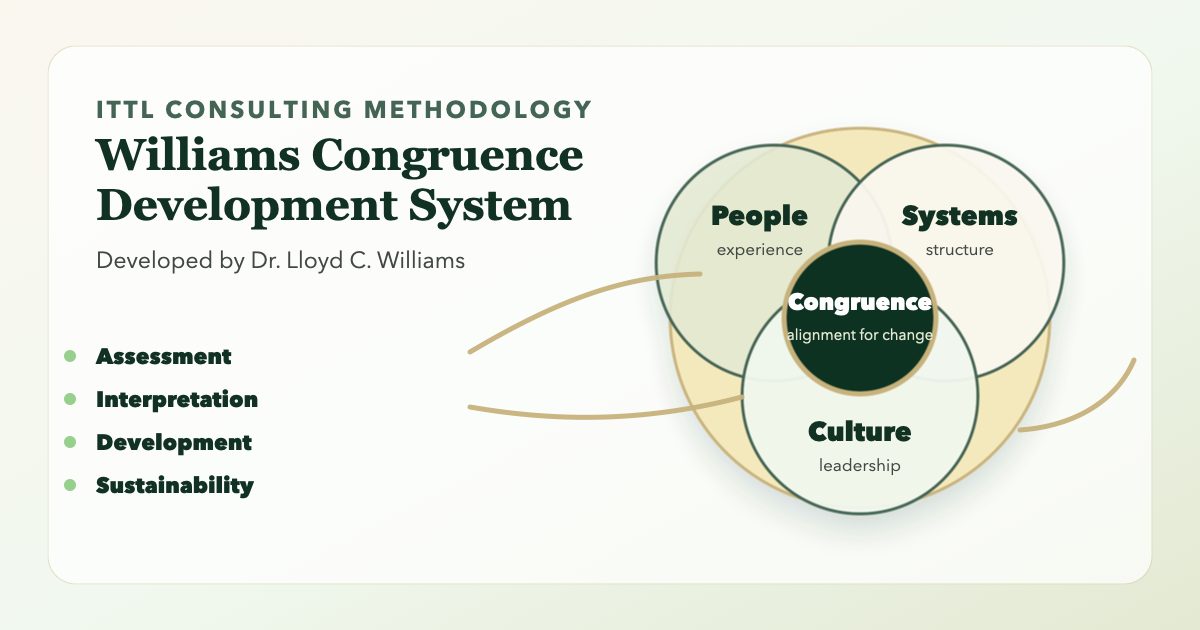
One system for multiple connections
While WCDS emphasizes people, systems, and culture to create congruence, the methodology’s practical applications extend across discrete and connected organizational sub-systems. Take for instance the following: each of these can be addressed in isolation or collectively.
- Lived experience
- Change capacity
- Leadership
- Values
- Formal structures
- Informal practices
- Communications
- Decision Making
Industry difference: personal & responsible change
The Williams Congruence Development System is neither a structural alignment model nor a tool. Nor does the development system prescribe a pre-existing structure for an organization based on temporary trends or insights.
Instead, the Williams Congruence Development System generates a personalized solution – which includes structural alignment – given each organization’s unique needs and talents across high-level (people, systems, cultures) and sub-system levels (leadership, lived experience, informal practices, etc.).
Once designed, the implementation plan to transform the organization does so responsibly by partnering with all impacted stakeholders. These relationships reduce potential backlash, increase participation, and minimize disruptions throughout the change process. For a breakdown of this approach, see the following steps below.

Assessment
ITTL Consulting leverages four proprietary auditing assessments to understand the organization’s unique challenges, gaps, and opportunities across culture, people, and systems.
Alignment
ITTL Consulting then reconciles that assessment against the organization’s stated goals and needs to develop a comprehensive 8-part needs report across systems, team performance, culture, organizational operations, organizational fit, time processing, human factor, and identified gaps.
Development
In partnership with organizational leadership, ITTL Consulting provides intermediate coaching and mentorship to address existing needs, while simultaneously developing an integrative strategic plan to close identified gaps.
Implementation
In collaboration with organizational stakeholders, ITTL Consulting will implement its integrative strategic plan across multiple business domain spaces: systems development, human factor development, cultural development, training, and integrative coaching.
Evaluation
In a final step, ITTL Consulting will develop unique tools to continuously evaluate and monitor organizational transformation, growth, and success.
Move from methodology to practical support
ITTL Consulting applies WCDS through the following services.
- Assessments & Audits
- Strategic Alignment
- Organizational Development
- Organizational Transformation
- Leadership Development
- Training & Development